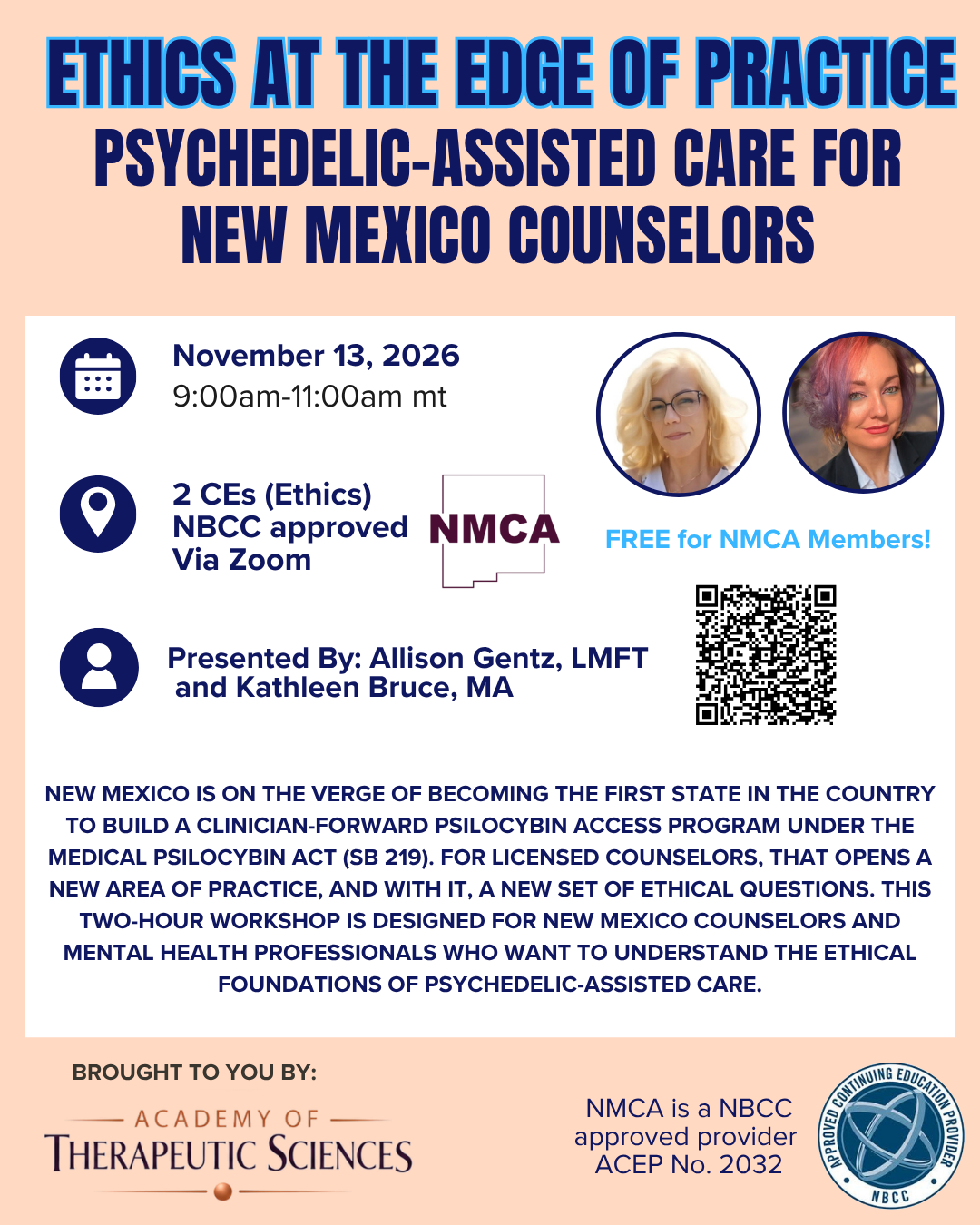
Ethics at the Edge of Practice: Psychedelic-Assisted Care for New Mexico Counselors
A special thank you to our Community Partner ATS for providing this presentation. The Academy of Therapeutic Sciences (ATS), an accredited natural medicine facilitator training program with a state-approved curriculum in Colorado,, Oregon, and coming to New Mexico.
Presented by: Allison Gentz, LMFT and Kathleen Bruce, MA
Hosted via Zoom
2 CEs (Ethics) approved by NBCC
New Mexico is on the verge of becoming the first state in the country to build a clinician-forward psilocybin access program under the Medical Psilocybin Act (SB 219). For licensed counselors, that opens a new area of practice, and with it, a new set of ethical questions.
This two-hour workshop is designed for New Mexico counselors and mental health professionals who want to understand the ethical foundations of psychedelic-assisted care before the state's rule is finalized. We'll ground the conversation in the ACA Code of Ethics, the NBCC Code of Ethics, and the New Mexico
Counseling and Therapy Practice Board's scope of practice, and then work through the ethical considerations that show up specifically in psychedelic-assisted work: informed consent in an altered state of consciousness, the ethics of touch and non-directive presence, cultural humility with traditional and Indigenous practices, screening and contraindications, power differentials, dual relationships in small-community settings, and the ethical use of integration.
The workshop combines short didactic segments with facilitated case discussion, small-group breakouts, and live Q&A, so counselors leave with both a conceptual framework and applied practice with the ethical dilemmas they're most likely to encounter.
Cost for CEs
Members: FREE | Non-members: $55
NMCA Membership: $70
Register by: 1/10/26 or before sales reach capacity
Learning Objectives
1. (Remember / Understand) Describe the current regulatory framework for medical psilocybin in New Mexico under SB 219, including the roles of the Department of Health, the Medical Psilocybin Advisory Board, and the Training and Education Committee.
2. (Understand) Explain at least three ways New Mexico's clinician-forward psilocybin framework differs from the Oregon (Measure 109) and Colorado (Prop 122 / DORA) models.
3. (Apply) Apply at least four provisions from the ACA and NBCC Codes of Ethics (informed consent, competence, boundaries, and referral) to a written case involving psychedelic-assisted care, citing the specific ethical provisions supporting each decision.
4. (Analyze) Distinguish at least five ethical considerations unique to psychedelic-assisted work from those already addressed by conventional counseling ethics, including consent in altered states of consciousness, ethics of touch and non-directive presence, and the counselor-client power differential in expanded-state work.
5. (Analyze) Analyze a case-based ethical dilemma involving screening, dual relationships in small-community settings, cultural considerations, and post-session integration, and articulate a defensible response grounded in the ACA and NBCC Codes of Ethics and the New Mexico scope of practice. 6. (Evaluate) Evaluate their own readiness, scope of practice, and continuing education needs relative to New Mexico's emerging practitioner and facilitator roles, and select the next steps in a training pathway consistent with that evaluation.
About the Presenters:
Allison A. Gentz is a multi state Licensed Marriage and Family Therapist who specializes in adult focused telehealth psychotherapy and intensive outpatient services for mental health and substance use treatment. She is licensed in California, Arizona, Nevada, and Colorado and currently resides in Las Vegas while serving clients remotely nationwide. Allison brings extensive experience in high acuity and complex clinical environments, including community mental health, forensic settings, and fully remote care models. Her work with organizations such as Spring Health, Rula, and Ocean Psychiatry focuses on evidence based care for anxiety, depression, trauma, life stressors, and co occurring substance use concerns. She provides individual and group therapy, including telehealth Intensive Outpatient Program groups, and is known for a hands on grounded style that emphasizes practical interventions and meaningful clinical outcomes. Clinically, Allison draws on CBT, DBT, and solution focused approaches while maintaining meticulous documentation aligned with ethical and licensing standards. Her background includes clinical supervision and leadership in outpatient settings, overseeing quality of care, regulatory compliance, and staff development.
Kathleen Bruce leads the design and implementation of the ATS Natural Medicine Facilitator Training, integrating didactic, practicum, and consultation components into rigorously assessed, adult‑learning‑aligned pathways. My work includes building assessment systems, teaching standards, and faculty development processes that support high‑quality, ethically grounded psychedelic care training. As a co‑founder, I drive strategic growth, technology and LMS infrastructure, and end‑to‑end admissions and CRM architecture, translating complex regulatory and market landscapes into coherent institutional systems. I bring a BA in History, MA in Communication, and advanced doctoral training in Higher Education Leadership, combining academic rigor with entrepreneurial execution in an emerging, highly regulated field.